

When you buy through our links, Business Insider may earn an affiliate commission. Learn more
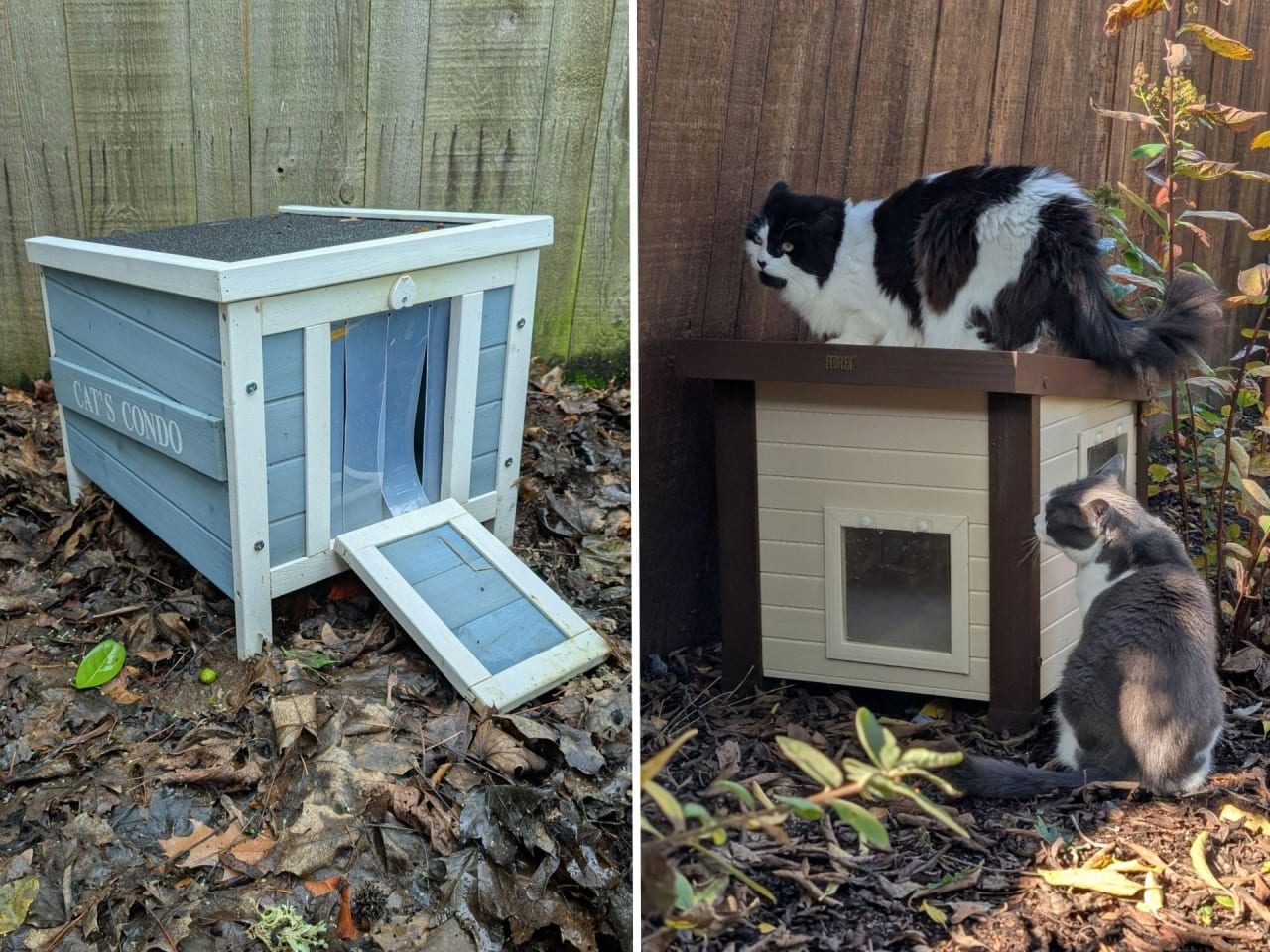
Outdoor cat houses offer stray and community cats protection from harsh weather.
Janelle Leeson/Business Insider
Outdoor life is tough on cats. Extreme temperatures, traffic, disease, and predators can shorten their lifespan. The best outdoor cat houses give community cats — whether they’re feral or friendly strays — a chance for improved welfare. They offer an insulated, weatherproof shelter when the weather turns, and a safer spot to rest. And when cats have a reliable home base, caretakers can better monitor their health.
To choose the best outdoor shelters for cats, I spoke with experts in community cat care and shelter medicine, along with an authority on pet product safety, expanding on earlier reporting by freelance pets reporter Shoshi Parks. Then, I put 11 cat houses to the test outdoors for at least 3 weeks each. Over that time, they endured 6.9 inches of rain and dropping temperatures in the Pacific Northwest. I also placed a heating pad inside each shelter to mimic a cat’s body heat, tracking how much the interior warmed while a heat source was inside and how well it held that heat after it was removed.
My top pick is the Trixie Natura Pet Home , a wooden shelter that’s waterproof, easy to maintain, and the most affordable prefabricated option, though you can’t beat the value of my DIY cat shelter recommendation. If winter temperatures in your area drop to near or below freezing, the Kitty Tube Outdoor Insulated Cat House effectively retains body heat in chilly outdoor conditions.
Read more about how Business Insider Reviews tests and reviews pet products .
Our top picks for the best outdoor cat houses
Best overall: Trixie Natura Pet Home – $50 at Chewy
Best insulated: Kitty Tube Outdoor Insulated Cat House – $195 at Amazon
Best for multiple cats: New Age Pet Feral Cat House – $86 at Chewy
Best pre-assembled: UnderCover Pet Houses Small Outdoor Cat House – $279 at Etsy
Best for garage: K&H Thermo Outdoor Kitty House – $80 at Chewy
Best DIY: Sterilite Storage Bins – See 18 Gallon ($7) and 30 Gallon ($12) bins at Walmart
Best overall
No matter the forecast, the Trixie Natura Pet Home is well-equipped to handle all weather conditions, and it’s easy to clean and prep for the next season. Even after several inches of steady Pacific Northwest rain and a direct hose spray to simulate heavier storms, the house never took on water. Its single baffled entrance helped retain heat in chilly weather. It’s also the most affordable prefabricated cat house on this list, making it a win-win for caretakers and the community cats who depend on them.
The house is elevated 3 inches off the ground, a height that Dr. Lauren Abrams , a veterinarian and intern at Maddie’s Shelter and Community Medicine Program at Cornell University, says is ideal. The best outdoor cat houses sit high enough to prevent flooding, keep cats off the cold ground, and prevent snow from blocking the entrance while still being easy to access. Even so, the wooden ramp leading to the entry offers a gently sloped incline to support cats with mobility limitations. My own cats were a little hesitant to use it; if your community cats are too, you can add a nonslip tread or remove the ramp entirely with a screwdriver.
The Trixie Natura Pet Home is a versatile option that provides reliable shelter for cats year-round.
Janelle Leeson/Business Insider
This shelter was the easiest to clean of those I tested. When the interior needed freshening up, I just lifted the hinged roof and propped it open with the built-in support. While the house isn’t insulated, you can add straw during cold weather and remove it when temperatures rise. Abrams prefers shelters that make it easy for caretakers to add or remove insulation so cats can stay comfortable year-round.
Best insulated
In cold weather, outdoor cats often seek warmth in dangerous places, including under car hoods. The Kitty Tube provides a safer alternative. Its fully insulated interior retained heat at a higher temperature and for longer than any other shelter I tested. The interior is protected by Scratch Guard, a scratch-resistant coating that blocks moisture, mold, mildew, and bacteria. A single, small entrance is fitted with an optional protective flap and awning to shield cats from wind, snow, and rain while deterring predators.
It’s also suitable for use in warmer weather. “Insulation works both ways. If the shelter has appropriate insulation and is placed in a shaded area, then it will stay cooler in the warm months,” says Aurora Velazquez , director of Best Friends Animal Society’s East Region. The space between the top insulation and the dome lid promotes airflow, and the carry handles can be adjusted for increased ventilation.
The extra-durable Kitty Tube offers cats reliable shelter from even the harshest winter conditions.
Janelle Leeson/Business Insider
The unique tube-shaped design helps limit drafts while accommodating a cat’s curled position. My cat found it especially comfortable, sprawling along the walls and flexing her claws across the foam insulation without causing any damage.
Although the shelter arrived nearly fully assembled and didn’t require any tools, it still took me about 15 minutes and some troubleshooting to set up the Kitty Tube. The tight-fitting components are great for heat retention and waterproofing, but make assembly a bit tricky. On day five, I noticed water inside and called customer service. I was routed directly to the shop owner and inventor of Kitty Tube, Jim Bradac, who patiently walked me through a simple fix, which involved tightening the top vent cap and gasket. The issue was resolved easily, and the experience reflected excellent customer support. The shell is also backed by a lifetime guarantee against chipping, cracking, or fading.
Best for multiple cats
Cats in established colonies are often bonded and tend to stick together, Velazquez says. However, not all community cats are part of a colony, and solitary cats often prefer multiple small shelters rather than a single shared space.
When providing the best outdoor cat houses for a bonded group, smaller is still better: A compact space with a lower ceiling retains body heat more effectively than a large house, Abrams says. The New Age Pet Feral Cat House is well-sized for two to three bonded adult cats, or a mother with kittens. While its sloped roof is slightly taller than ideal, laying straw on the floor and building it up at least halfway along the walls can improve heat retention.
The New Age outdoor cat house is a larger option that can comfortably shelter two to three cats or a mother with kittens.
Janelle Leeson/Business Insider
For single-cat shelters, one entry door is ideal, but Abrams says two doors work best for shared spaces. The doors on this shelter are baffled and slightly off-center, keeping cats out of the direct path of wind and rain. While the elevated design and baffled entrances kept most rain out, I noticed a small gap at the edge of the baffle, which let in a few droplets and slightly reduced heat retention.
The house is constructed from Ecoflex, an eco-friendly composite of polymers and wood fiber byproducts that is durable and moisture-repellent for comfort and easy cleanup. It’s also covered by a 10-year limited warranty. Cleaning the interior or refreshing the insulation, however, requires removing four screws from the roof using the included specialized tool. Misplacing that tool could make maintenance tricky.
Best pre-assembled
The best pre-assembled outdoor cat house removes all the guesswork, tools, and setup time from creating a safe haven for outdoor cats — all you have to do is set it in place. UnderCover Pet Houses provides just that with this fully assembled, wooden shelter. Though pricier, Abrams recommends it for its beautiful design and high-quality construction.
UnderCover Pet Houses lets you customize your ready-to-use cat shelter, including the option to choose one or two doors. Unless you’re dealing with a known prevalence of predators or territorial disputes, a second door usually isn’t necessary. “More holes in a shelter introduce more outside air and allow the warm inside air to escape, making the shelter less effective,” Velazquez says. You can also add a plastic baffle or awning to shield the entrance from wind, rain, and predators. I chose a single baffled door without an awning, which kept the rain out — but not my cat, who quickly cozied up inside.
This pre-built house from UnderCover Pet Houses is an easy option for sheltering community cats.
Janelle Leeson/Business Insider
Since every joint is caulked and both the walls and ceiling are insulated, the house did a great job retaining heat. The floor is also slightly elevated off the ground. While my experts still recommend adding straw for extra warmth and coziness, the interior is a bit narrower than ideal. With insulation added, the smaller size is not suited to larger cats. My 11-pound, 20-inch-long cat could comfortably enter and turn around without the straw, but adding it made maneuvering difficult. When the shelter was packed with straw, my 10-pound, 19-inch-long cat could still enter and turn around comfortably. Although no assembly is required, you’ll need to remove six screws to take the roof off for cleaning.
Best for garages
“In general, if it’s too cold for you to be outside for any length of time, it is certainly too cold for cats to be outside without proper shelter,” says Dr. Stephanie Ninnemann , a veterinarian at VCA Spring Creek Animal Hospital in Jackson Hole, Wyoming. When below-freezing temperatures are in the forecast, outdoor cats should be housed inside a barn or shed with access to heat, water, and food.
The K&H Thermo Outdoor Kitty House is ideal for these sheltered spaces and includes a removable, weight-activated heat mat. Assembly took five minutes, and my cats refused to stay out of it. The house is made from lightweight, vinyl-backed nylon and features a removable velcro-attached roof with overhanging eaves. The plastic door flaps can be removed if preferred. Although the shelter may be just big enough for two small cats to snuggle, my cats adamantly refused to share — and for many community cats, the interior would be too cramped for two.
This cat house from K&H Pet Products includes a weight-activated heating mat to keep cats comfortable in below-freezing temperatures.
Janelle Leeson/Business Insider
Safety is just as vital. The best outdoor cat houses use low-voltage electricity and outdoor-rated wiring that’s well concealed, says Lindsey Wolko , founder and CEO of the Center for Pet Safety . The K&H Thermo Outdoor Kitty House features a low-voltage, 20-watt orthopedic mat that’s MET safety-listed , meaning it has been independently tested and approved. Still, you should place water bowls well away from the cord and plug.
Even waterproof structures can collect condensation. Because the heating pad is susceptible to absorbing moisture, it could become damp or even freeze, which can put outdoor cats at risk. For that reason, I don’t recommend using this house outside of sheltered areas. To clean it, remove the heating pad and wipe down the interior with a damp cloth. You can also put the removable heating pad cover in the washing machine.
Best DIY
“One of the most used materials for shelters are plastic totes, usually lined with styrofoam and straw. They’re among the most waterproof kinds of shelters,” Velazquez says. After experimenting with a few different storage totes, I found that Sterilite’s 18-gallon and 30-gallon bins made the best outdoor cat houses. They’re budget-friendly, waterproof, roomy enough to comfortably house two to three bonded cats or a mother with kittens, and effective at retaining heat — all reasons Velazquez prefers a well-built DIY cat shelter over even the best prefabricated models.
After gathering a box cutter, hair dryer, marker, plastic nursery pot, and straw and Styrofoam for insulation, assembly took roughly 15 minutes. Following Alley Cat Allies’ step-by-step guide , I built a double-insulated shelter by cutting entry doors, nesting one bin inside another, filling the space between them with insulation, lining the inner bin with straw, and securing both lids.
Sterilite totes proved to be the best option for building a durable, comfortable outdoor cat house.
Janelle Leeson/Business Insider
I found that flexible plastic totes like these from Sterilite were sturdy yet pliable enough to cut, especially after warming them with a hairdryer. Another set of bins was so rigid that they were nearly impossible to cut, and their handles prevented the smaller bin from properly nesting inside the larger one. Abrams recommends sanding the edges of the cut doorway to prevent injuries as cats enter and exit. I also needed duct tape to keep the door in place. The plastic flowerpot I used created a snug 5.38-inch entry, which was a bit tight for my 11-pound cat. A tapered 1-gallon nursery pot, measuring closer to 7 inches in diameter, may provide a more comfortable opening.
What to look for in outdoor cat houses
Outdoor cats require a shelter that can withstand all weather conditions — from cold winter nights and heavy rain and wind to summer heat. The experts I spoke to say if you focus on a few key features, you can find the best outdoor cat house to keep your neighborhood community cats safe all year.
Weather resistance: Even the fluffiest of cats are no match for inclement weather. “A cat’s fur only keeps them warm when it’s dry,” says Dr. Erin Katribe , veterinarian and medical director at Best Friends Animal Society. When temperatures drop to 45 degrees or below, cats are at risk of frostbite and hypothermia, especially if they’re wet.
Water-resistant construction. Look for shelters made from waterproof or water-resistant materials that prevent rain and snow from seeping in and help keep cats dry and warm. Features such as the caulked seams on the UnderCover Pet House help block drafts and moisture from entering through gaps.
Slanted or pitched roofs. These prevent water from pooling on top of the shelter, reducing leaks and extending the life of the structure.
Protected doorways. Baffled entrances, overhangs, or awning-style door covers help block wind, rain, and snow from blowing inside. However, some cats may be deterred by plastic flaps. Choosing a shelter with removable baffling, such as the Kitty Tube, K&H Thermo Outdoor Kitty House, or New Age Feral Cat House, allows you to adjust the setup to suit your cats’ preferences.
Raised floors. Abrams recommends elevating outdoor cat shelters 3 to 5 inches off the ground to prevent the floor from getting wet, reduce snow buildup at the entrance, and make the shelter less accessible to wildlife or predators. Elevation also improves airflow and helps a cat’s body heat warm the interior more efficiently. If the shelter isn’t already raised, you can place it on bricks, pallets, or similar supports. Keep in mind that doors higher than 5 inches from the ground may be difficult for a cat to access.
Insulation. “Insulation is a key part of keeping shelters warm, and it should not be skipped,” Velazquez says. It helps maintain a cat’s core temperature during cold nights and also blocks heat in the summer, keeping the shelter comfortable year-round. Some cat houses come with built-in insulation, such as the UnderCover Pet House. Others such as the Kitty Tube are designed with removable insulation. You can also start with an uninsulated shelter and customize it for your climate.
While materials like egg cartons, Mylar, or Styrofoam can work, both Velazquez and Abrams strongly recommend using straw rather than hay in your cat house. “Straw is the best option to keep the inside of the shelter dry, as it repels moisture, can easily be changed out, and provides a comfy area for cats to rest and burrow into,” she says. In contrast, hay absorbs water, stays wet, becomes cold and uncomfortable, and can quickly develop mold. Even if your cat house comes insulated, adding straw creates a warmer, more inviting interior.
Ease of assembly: Prefab outdoor cat houses should require minimal assembly and have straightforward, easy-to-follow directions. I favored shelters that are quick to assemble, with only one or a few tools. Of the DIY houses, I selected the one requiring the least technical skill to build while offering the most benefit to community cats.
Ease of maintenance: Outdoor cat houses should be easy to clean, resistant to odors, and simple to refresh from season to season. They should also allow for adding or replacing insulation, such as straw, when needed. Abrams recommends changing out the straw once to twice per season.
Size: Abrams recommends an interior of roughly 12″L × 18″W × 12″H for a single cat, increasing the dimensions by 1.5 to two times the size for each additional cat. This is just enough space for an average cat to stand up and turn around comfortably. These compact shelters trap body heat more efficiently, helping to keep cats warm.
Entry and exit points: A cat house with two entrances can make it easier for cats to escape if there is a prevalence of predators, such as coyotes, or a history of conflict between community cats around territory or resources. Two entry points are also recommended when housing more than one cat in a single shelter. Outside of these circumstances, it’s recommended to look for a shelter with one door only. The more doors on a cat house, the more likely it is for rain to enter or heat to escape.
Door size: Abrams recommends that doors be 6 to 8 inches wide. “Any smaller, and some of the thicker kitties will not be able to enter. Any larger, and you may find yourself with more than just cats in the shelter,” she says.
Cost: Outdoor cat houses come in a range of styles and prices to suit different needs. Pre-assembled shelters, for example, come at a premium because they’re ready to go straight out of the box. Velazquez was also happy to pay a little more for aesthetic value. “When I added a shelter to my backyard among the landscaping, I opted for one of the wooden ones. It looked great and was a hit among the cats, but fared worse in the elements over time than my storage container ones,” she says. If longevity is important to you, the Kitty Tube is also pricier, but it comes with excellent customer support and a durable shell backed by a lifetime guarantee. On the other hand, my DIY option cost a fraction of the price and performed just as well at retaining heat and keeping water out — but it likely won’t last through a lifetime of seasons.
How we tested the best outdoor cat houses
I researched different types of houses based on our experts’ recommendations and reviewed options available at major online retailers. From there, I selected nine shelters to test against the elements.
Ease of assembly: I evaluated how easy it was to assemble each cat shelter. I timed the setup, assessed the clarity of instructions, and noted any issues. Cat houses that include all the necessary tools for one-person assembly received higher scores.
Durability: I assessed how well each shelter would hold up over time and through various weather conditions.
Initial inspection: Once fully assembled, I checked all parts — seams, joints, and any glued, screwed, or snapped-in pieces — for stability. I gently tugged on panels, doors, and roofing to spot any looseness or weak points.
Heat retention test: I placed the shelter outside and recorded both the outdoor temperature and the internal baseline temperature of the shelter. I then placed a heating pad inside the shelter and tracked the internal temperature at 10-minute intervals for 30 minutes to see how effectively the shelter warmed. After removing the pad, I continued to measure the shelter’s temperature every 10 minutes for another 30 minutes to evaluate heat retention.
Water retention test: Using a hose, I sprayed the shelter for 5 minutes, noting any leaks or pooling inside.
Structural integrity test: I applied consistent pressure to the walls and roof using a luggage scale and placed a 10-pound sandbag on the roof for 24 hours to simulate snow accumulation. I then inspected the shelter for sagging, warping, or other signs of damage.
Field test: Each shelter was left outdoors for three to four weeks during the Pacific Northwest rainy season. In total, the houses were outside for 40 days, enduring 6.9 inches of rain and dropping temperatures. I documented any shifting, warping, or weakening of materials over time.
Biologically appropriate features: I considered multiple features that make the best outdoor cat houses cat-friendly.
Size: Cats should be able to stand and turn comfortably, but houses should not be so large that body heat easily escapes.
Door type and size: Small or baffled doors keep out wind, rain, cold, and predators. Awnings also help keep rain and snow out.
Elevation: Shelters should be raised to keep floors dry, prevent snow blockage, improve airflow, and reduce access by wildlife.
Accessibility: Elevated shelters should not be so high that cats with limited mobility cannot easily enter.
Temperature regulation: Insulation, a solid floor, and slight elevation help keep cats dry and warm. I chose shelters with built-in insulation or ones that could be outfitted with Mylar, Styrofoam, or straw. Heated shelters should use outdoor-rated electrical connections with auto-shutoff or other safety features.
Ease of maintenance: I insulated each shelter with straw, then removed and cleaned it, assessing how easy it was to access the interior, swap bedding, and prepare the house for the next season. I preferred shelters that didn’t require removing screws or parts to clean, as long as the structure remained water-resistant and secure.
Cat preference: While my indoor cats don’t have the same urgent need for shelter and warmth as community cats, observing how they used each house provided valuable insight into accessibility, size, and features that could encourage or deter a cat in need.
Outdoor cat house FAQs
What kind of house does an outside cat need?
Outdoor community cats require shelter that stays dry and is properly insulated. Fill the shelter with more straw than you think you might need to make the shelter warmer and more inviting, says Velazquez.
A well-maintained shelter clear of debris and filled with clean straw will be far more appealing than a neglected one, Abrams says. Placement can also make a shelter more inviting: Locating the shelter in a low-traffic area, near the cat’s colony, or against a structure that helps block wind and rain can make it feel safer. “A warm, well-positioned shelter is more than likely to be found by the cats who need it,” she says.
How should I clean my cat’s house?
Abrams recommends replacing the straw in your cat shelter once or twice per season, and any time it becomes soiled. Between seasons or when dirty, wash the shelter with mild soap and water. Allow the shelter to dry completely before replenishing it with straw.
What is the best size for an outdoor cat house?
Once outfitted with the appropriate amount of insulation for the season, a cat should be able to comfortably stand up and turn around within the shelter, as larger houses are less efficient in retaining body heat. Abrams says an internal size of 12″ L x 18″ W x 12″ H is appropriate for one cat. For each additional cat using a shelter, she recommends increasing the dimensions by 1.5 to 2 times the size.
Do outdoor cat houses need litter boxes?
No, community cats generally do not need litter boxes. Most are resourceful and will find discreet places to eliminate on their own. Placing a litter box near an outdoor shelter can unintentionally attract wildlife. Cat feces can also spread disease to people , and outdoor litter boxes should be made inaccessible to children.
However, if the community cats you care for are eliminating in your garden or other unwanted areas, you can offer litter boxes, with some considerations. “Litter boxes for outdoor colonies aren’t something we see very commonly because of the maintenance required,” Abrams says. You’d need to provide one litter box area per cat plus one extra. Because colonies often include more than five cats, managing that many boxes can become challenging, especially because they should be scooped daily and deep-cleaned weekly. Rather than using one of the best cat litters for indoor cats, add sand or peat moss to the box. The boxes should be placed in a covered, weather-protected spot such as an indoor/outdoor garage or accessible shed, away from food and water.
Do feral cats use outdoor cat houses?
Yes. “Community cats — the broader umbrella term that encompasses feral cats as well as friendly strays — are extremely resourceful and will do their best to find shelter from the elements,” Velazquez says. Feral cats differ from strays in that they generally avoid any interaction with humans, making them less likely to be seen. As a result, truly feral cats may prefer shelters placed away from human activity, close to their colony location. Abrams emphasizes that if you plan to help colony cats by providing shelter and food, it’s just as important to get them spayed or neutered and vaccinated. She says the most common issues communities encounter with sheltered feral cats are reproductive-related behaviors, such as urine marking, fighting, and yowling.
What is the best way to heat an outdoor cat house?
“Straw is hands down the best and most cost-effective insulation,” Velazquez says. Other suitable insulation options include egg cartons, Mylar, and Styrofoam. Never attempt to insulate an outdoor shelter with blankets or other fabric. “Blankets are very absorbent and can not only provide a host for bacteria and mold to grow, but wet blankets can freeze, turning what should be a toasty shelter into an icebox,” she says. Cat houses equipped with low-voltage heating pads and outdoor-rated cords can be placed inside sheltered areas, such as a garage or porch.
How do outdoor cats stay warm in the winter?
Cats conserve body heat by curling up in tight, cozy spots that are safe from wind, rain, and snow. Many outdoor cats seek shelter somewhere elevated to take advantage of rising heat or find their way under the hood of a car to the still-warm engine. Others will huddle together with other cats to share body heat. Because cats burn through so much energy trying to stay warm, they also benefit from eating frequent large meals to make up that lost energy.
Do outdoor cats need a cat house?
If your cat spends time outside, they may appreciate a cat house as a safe place to relax or find shelter from the weather. A cat house can help them stay warm in the winter and find shade in the summer. They also provide a dry place to nap on rainy or snowy days. In extra cold conditions, a heated shelter is better than an unheated shelter for preventing hypothermia. However, most cats in more moderate climates will do just fine with a well-insulated, waterproof cat house.
Are outdoor cat houses safe?
Yes, outdoor cat houses are safe for cats as long as they’re well-maintained and used properly. That said, outdoor cat houses are meant for community cats already living outdoors, not to encourage transitioning indoor cats to outdoor living — indoors is the safest place for cats. When insulating a cat house, straw is the best option. Improper insulation with blankets or other moisture-trapping fabrics can put cats at risk of frostbite or hypothermia. Avoid placing food inside the shelter, which can attract wildlife. In areas with known wildlife or territorial disputes, a second door can provide an alternative escape route for cats. Otherwise, one small entry is ideal for retaining heat.
Where’s the best place to put an outdoor cat house?
Whenever possible, place cat shelters near buildings or other permanent structures, which can help protect them from the elements and provide extra warmth. A wall, porch, or a spot tucked into shrubs can block strong winds, keep the shelter warmer, and even provide a bit of camouflage. In the summer, move the shelter into a shaded area to prevent overheating. For feral cat shelters in an established colony, choose a location where property owners and neighbors are informed about feral cat care, Abrams says. Attaching a laminated sign to the shelter can help explain its purpose, and adding a bike lock can help keep it in place.
What should I put inside an outdoor cat house?
The only thing you need inside an outdoor cat house is straw. “Materials like fabrics or cushions absorb moisture and can freeze, creating an ideal scenario for hypothermia,” Wolko says. While it’s important to provide water for community cats, it should be placed near — but not inside — the shelter. “Placing food or water inside the shelter can attract wild creatures into the cats’ safe space,” Abrams explains. Velazquez adds that food and water can also introduce moisture and organic matter, which can lead to mold inside your shelter.
Read the original article on Business Insider


