

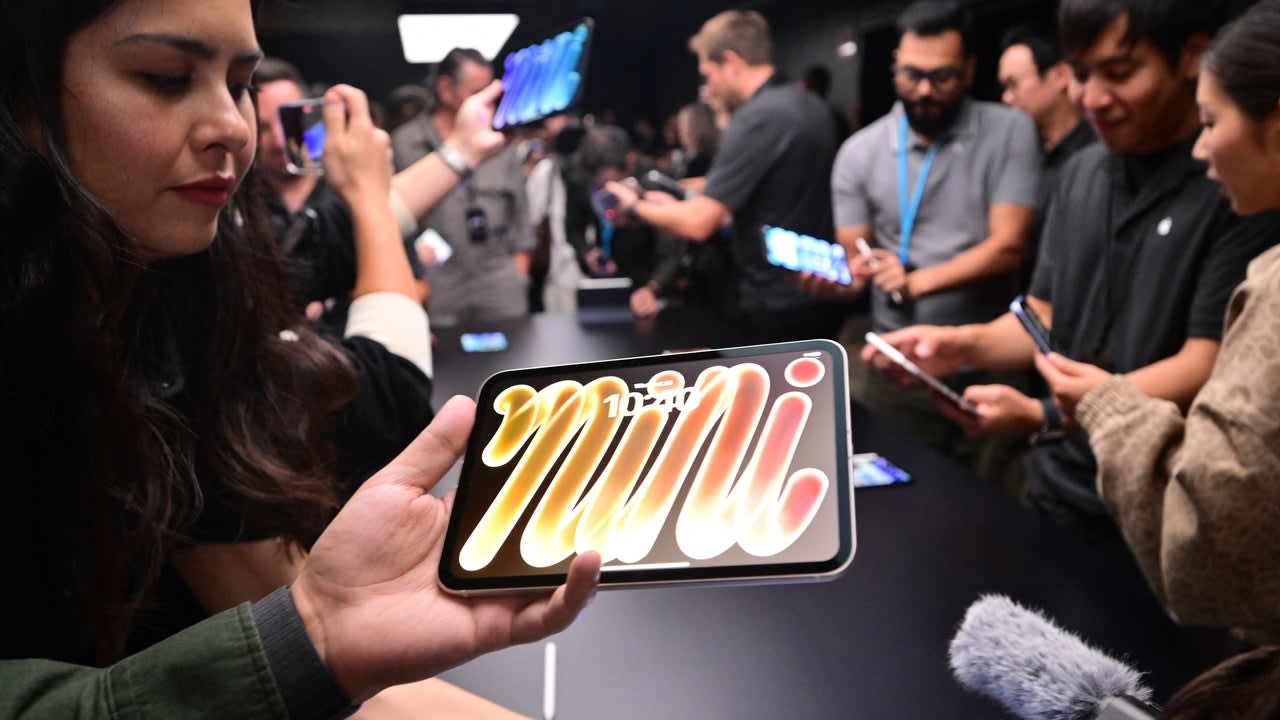
On paper, there’s a lot to like about the new iPad mini that Apple announced this week. Now in its eighth generation, Apple is calling the latest model the biggest upgrade in the product’s history, and that actually feels like a reasonable claim.
The most eye-catching addition to the new iPad mini is an 8.5-inch OLED display that fits into about the same footprint as the previous 8.3-inch LCD model due to 24% thinner bezels. The device itself is also thinner, dropping from 6.3 millimeters to 5.4 millimeters, while weight has been reduced by 14% to 255 grams. That’s a big improvement for a tablet many people would use for one-handed reading.
Apple didn’t skimp on the internals, either. The new mini jumps three silicon generations, from the A17 Pro to the 2-nanometer A20 Pro chip that’s also in the iPhone 18 Pro. Apple gave the mini Wi-Fi 7 and Bluetooth 6 through the in-house N1 wireless chip, as well as using its own C2 5G modem. There’s also an “Acoustic Display” speaker system that vibrates woofers through the panel and helped Apple achieve an IP67 water- and dust-resistance rating, in a first for an iPad.
{“blockType”:”mv-promo-block”,”data”:{“imageDesktopUrl”:”https://images.fastcompany.com/image/upload/f_webp,q_auto,c_fit/wp-cms-2/2025/12/multicore.png”,”imageMobileUrl”:”https://images.fastcompany.com/image/upload/f_webp,q_auto,c_fit/wp-cms-2/2025/12/multicore-mobile.png”,”eyebrow”:””,”headline”:”u003Cstrongu003Eu003Cstrongu003ESubscribe to u003Cemu003EMulticoreu003C/emu003Eu003C/strongu003Eu003C/strongu003E”,”dek”:”u003Cemu003EMulticoreu003C/emu003E is about technology hardware and design. It’s written from Tokyo by Sam Byford. To learn more, visit u003Ca href=u0022https://www.multicore.blog/u0022u003Emulticore.blogu003C/au003E”,”subhed”:””,”description”:””,”ctaText”:”SIGN UP”,”ctaUrl”:”https://www.multicore.blog/”,”theme”:{“bg”:”#f5f5f5″,”text”:”#000000″,”eyebrow”:”#9aa2aa”,”subhed”:”#ffffff”,”buttonBg”:”#000000″,”buttonHoverBg”:”#3b3f46″,”buttonText”:”#ffffff”},”imageDesktopId”:91454027,”imageMobileId”:91454030,”shareable”:false,”slug”:””,”wpCssClasses”:””}}
A glaring omission
But for all these legitimate upgrades, Apple left out one feature that anyone with a recent iPhone is likely to notice as soon as they start scrolling. The 2026 iPad mini’s OLED screen is still locked at 60 Hz, with no support for Apple’s 120 Hz ProMotion variable refresh rate technology, which gives a much smoother experience on iPhones and the iPad Pro.
While I liked the size of the previous iPad mini, the 60 Hz screen was the main reason I sold it. It doesn’t bother me much on larger devices like laptops or desktop computers, but the iPad mini screen is small enough that it feels more in keeping with smartphone technology. You’re usually just looking at a single app at once, and expecting it to respond to your touches.
I would have been all on board with an OLED iPad mini with ProMotion, but Apple lost my sale with this decision. So why might the company have made it?
The backstory
Apple first introduced ProMotion on the 10.5-inch iPad Pro, as well as the second-generation 12.9-inch model, in June 2017. Those devices used LCD panels with IGZO (indium gallium zinc oxide) thin-film transistor backplanes, which allowed them to dynamically scale their refresh rates between 24 Hz and 120 Hz depending on what was on-screen or whether you were touching it.
There’s a good reason to do this: Running the screen at high refresh rates when you aren’t doing anything motion-sensitive is an unnecessary waste of GPU power and battery life. Apple continued to use IGZO backplanes for the iPad Pro when it switched to mini-LED backlighting alongside the MacBook Pro in 2021.
That same year, Apple also figured out how to bring ProMotion to the iPhone with a completely different type of panel. The iPhone 13 Pro was the first iPhone to use an OLED screen with an LTPO (low-temperature polycrystalline oxide) backplane, allowing similar variable refresh rates to the iPad Pro.
This was four years after the launch of the first OLED iPhone, the original iPhone X. That phone used an LTPS (low-temperature polycrystalline silicon) backplane, which is likely why Apple locked the refresh rate to 60 Hz. And according to supply chain reports, the new iPad mini uses a Samsung Display panel based on LTPS technology.
The “O” oxide semiconductor in IGZO and LTPO is what enables Apple’s take on ProMotion technology. Because of electrical leakage, LTPS screens need to refresh constantly—usually at a fixed rate of 60 Hz or 120 Hz—or their electrical charge drains and visual quality deteriorates. Oxide transistors act as a seal, locking the charge inside each pixel.
Given the new iPad mini’s slimmer frame and slightly smaller battery, Apple was likely unwilling to compromise on power efficiency by using an LTPS display. And with rising memory costs contributing to a much higher base price of $699 for a 128 GB model, the company will have welcomed savings anywhere it could get them.
But LTPO panels are no longer an expensive, exotic technology. Apple offers ProMotion on the regular iPhone 17 and 18, for example, and it’s hard to imagine an iPad mini LTPO upgrade making much of a dent in the $200 price hike compared to a couple of years ago. (Apple did raise the starting price on the previous model to $599 in June.)
The wrong call
I’m sure Apple has its reasons, but I think this was the wrong call. The iPad mini was already a pretty niche product, priced higher than the entry-level iPad with a larger screen, and this new iteration is even more focused on enthusiasts. By upping the storage and adding a nano-texture finish, it can cost as much as $1,249. Would an extra $50 really have moved the needle, sales-wise?
It’s possible that Apple wanted to encourage upsells to the 11-inch iPad Pro, which now starts at $1,199. But I think these are fundamentally different kinds of devices. You’re probably not going to sit at a desk with a trackpad-equipped keyboard for your iPad mini, for example. This is a touch-first product not all that far removed from a large phone. In fact, its closest equivalent is the new iPhone Duo, which also has ProMotion on both of its screens.
But even if you don’t want to spend $1,999 on a folding phone, Apple is right to market ProMotion as a feature that adds mainstream value to the standard iPhone 17 and 18. That’s why it should also be there on the iPad mini.
{“blockType”:”mv-promo-block”,”data”:{“imageDesktopUrl”:”https://images.fastcompany.com/image/upload/f_webp,q_auto,c_fit/wp-cms-2/2025/12/multicore.png”,”imageMobileUrl”:”https://images.fastcompany.com/image/upload/f_webp,q_auto,c_fit/wp-cms-2/2025/12/multicore-mobile.png”,”eyebrow”:””,”headline”:”u003Cstrongu003Eu003Cstrongu003ESubscribe to u003Cemu003EMulticoreu003C/emu003Eu003C/strongu003Eu003C/strongu003E”,”dek”:”u003Cemu003EMulticoreu003C/emu003E is about technology hardware and design. It’s written from Tokyo by Sam Byford. To learn more, visit u003Ca href=u0022https://www.multicore.blog/u0022u003Emulticore.blogu003C/au003E”,”subhed”:””,”description”:””,”ctaText”:”SIGN UP”,”ctaUrl”:”https://www.multicore.blog/”,”theme”:{“bg”:”#f5f5f5″,”text”:”#000000″,”eyebrow”:”#9aa2aa”,”subhed”:”#ffffff”,”buttonBg”:”#000000″,”buttonHoverBg”:”#3b3f46″,”buttonText”:”#ffffff”},”imageDesktopId”:91454027,”imageMobileId”:91454030,”shareable”:false,”slug”:””,”wpCssClasses”:””}}


