

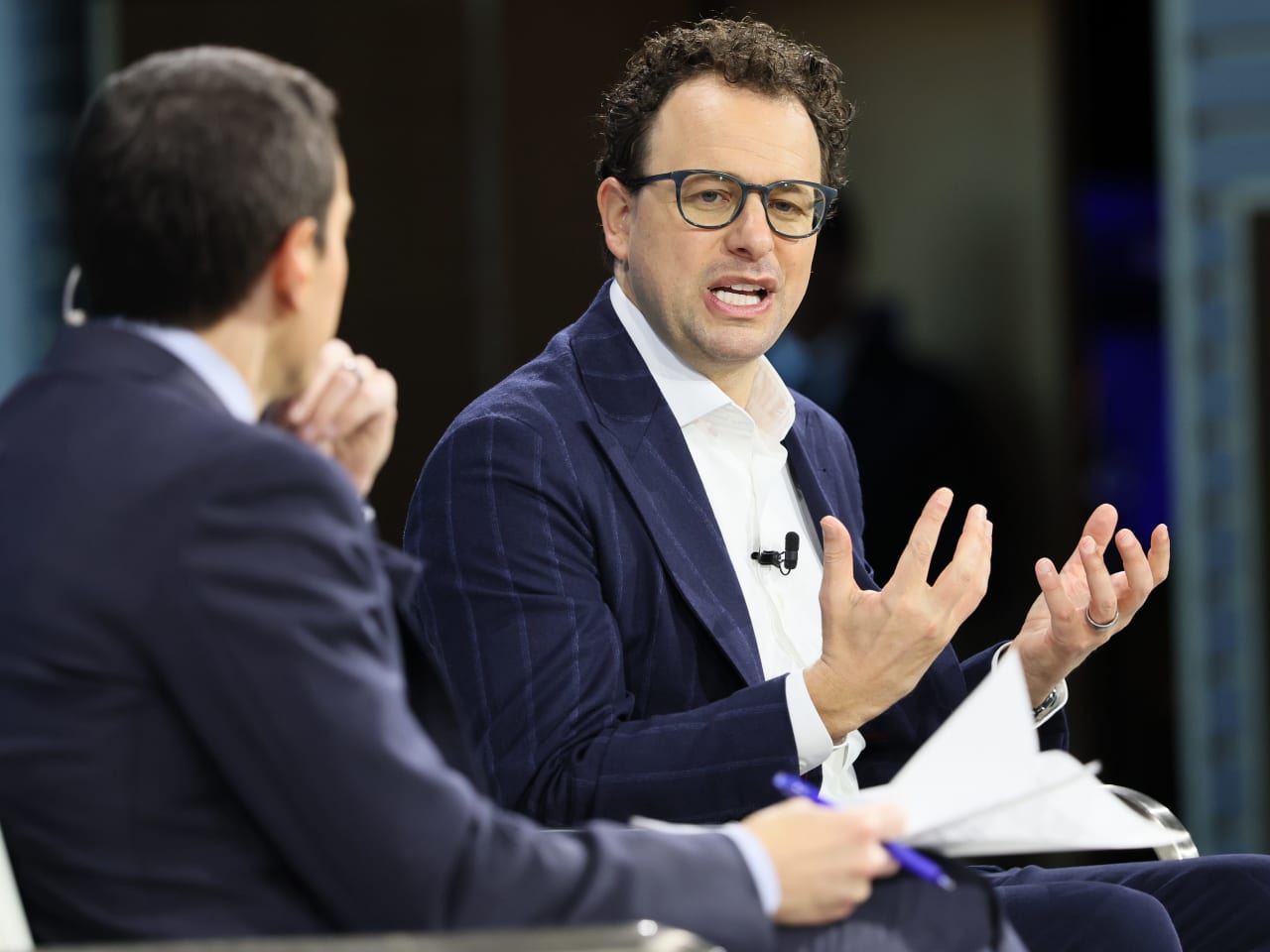
Anthropic CEO Dario Amodei
Michael M. Santiago/Getty Images
Anthropic’s IPO lock-up uniquely spans 365 days, differing from typical three- to six-month periods.
Some Anthropic shareholders can sell shares on the day the stock starts trading, defying norms.
Anthropic’s titanic IPO will be a major test of investors’ confidence in the AI trade
The structure of Anthropic’s post-IPO lock-up period is unusual.
When a company goes public, its insider shareholders can only cash in their equity after a certain amount of time, so as to support the stock price by not flooding the market with shares all at once.
Typically, lock-up periods that prohibit insiders from selling stock last three to six months. In many cases, there are mile markers along the way that allow for some additional selling before a final expiration date when virtually all shares can be freely offloaded.
For example, SpaceX , which went public in June, will see its general lock-up period expire in December, 180 days after its June 12 IPO (Elon Musk is locked up for a full year, until June 2027).
Anthropic’s S-1 filing released on Monday, however, shows the company’s lock-up structure is much more unorthodox and complex.
Here’s the schedule at a glance, according to the S-1:
“Non-founder directors, officers, and certain current or former employees or consultants” can sell up to 10% of shares they hold on day one. This group can sell another 35% after the release of full year 2026 financial results.
Other stockholders can sell in specified waves beginning 27 days from the filing of the IPO prospectus, with many more tranches unlocking over time following the release of full year 2026 results. Most of the insider shares become unlocked in this stretch.
Founders can transfer 29% of their stock around 180 days after trading begins, with the rest of their holdings unlocking after a full year.
So, for one, some top shareholders will have to wait a full 365 days before they can offload their stock. On the other side of that spectrum, some shareholders will be allowed to sell a portion of their shares as soon as the stock begins trading.
Finally, there’s an extraordinarily high number of lock-up expiration dates stretched over a long period of time: shareholders will be able to dump shares on more than 20 different release dates in the year after the IPO. SpaceX, by comparison, had fewer than 10 lockup expiration dates.
It may look unusual, but it could potentially be a help for the stock price, which often sags in the months following a company’s IPO.
Stocks have historically performed poorly in the few months after their IPOs, so limiting the supply of shares released into the market could reduce potential downside.
The stretched, more incremental lock-up period could be slow the number of Anthropic shares coming to the market. Rather than a deluge, investors will get a trickle of stock at frequent intervals.
“If you look at the last 30 major tech IPOs, 57% traded up over the first week. However, the max drawdown in the first year averaged 55%,” Andy VandenBerg, founder of VDB Wealth, told Business Insider this summer ahead of SpaceX’s IPO.
Still, the unusual schedule was a source of source intrigue among IPO-watchers around the internet on Monday.
“The longer timeframe is also sort of a retention technique?” wondered one X user following the publication of the S-1. Another X user called the drawn-out schedule “insane.”
Looking at SpaceX again, the company’s stock fell as much as 46% in the few months after it went public, then began to recover.
Anthropic’s IPO will be a major test of the AI trade. The company, with its various Claude models being some of the most widely used chatbots, is expected to go public at a market cap of $1.5 trillion to $2 trillion, which would put it in the top 10 largest companies in the world.
“We believe that AI is one of the most consequential technologies in human history,” Anthropic said in its filing, adding that the technology could increase economic growth and even cure diseases. “Anthropic aims to realize these benefits while navigating and preventing the risks that come with a technological revolution this fast and this powerful.”
Its S-1 filing shows a total net loss of about $42 billion in 2025, with revenue of $4.6 billion. In the first six months of this year, Anthropic recorded a loss of $80.7 billion.
The IPO comes as the vibe has shifted for investors, who are increasingly wondering about how far the AI boom can stretch on. The market seems to remain skeptical that hyperscalers can monetize their mammoth spending on AI infrastructure, while also fearing what a pullback in capex might mean.
“Anthropic is taking a calculated risk by pursuing an IPO while the window of opportunity is open,” said Shashi Bellamkonda, Principal Research Director at Infotech.
“It has already demonstrated enterprise demand and is betting that its brand and capabilities will give investors confidence,” he continued. “But the US market can be fickle, and investors are questioning whether AI spending will deliver returns. This IPO will test both confidence in Anthropic and investor appetite for other AI companies considering a public listing.”
Read the original article on Business Insider


