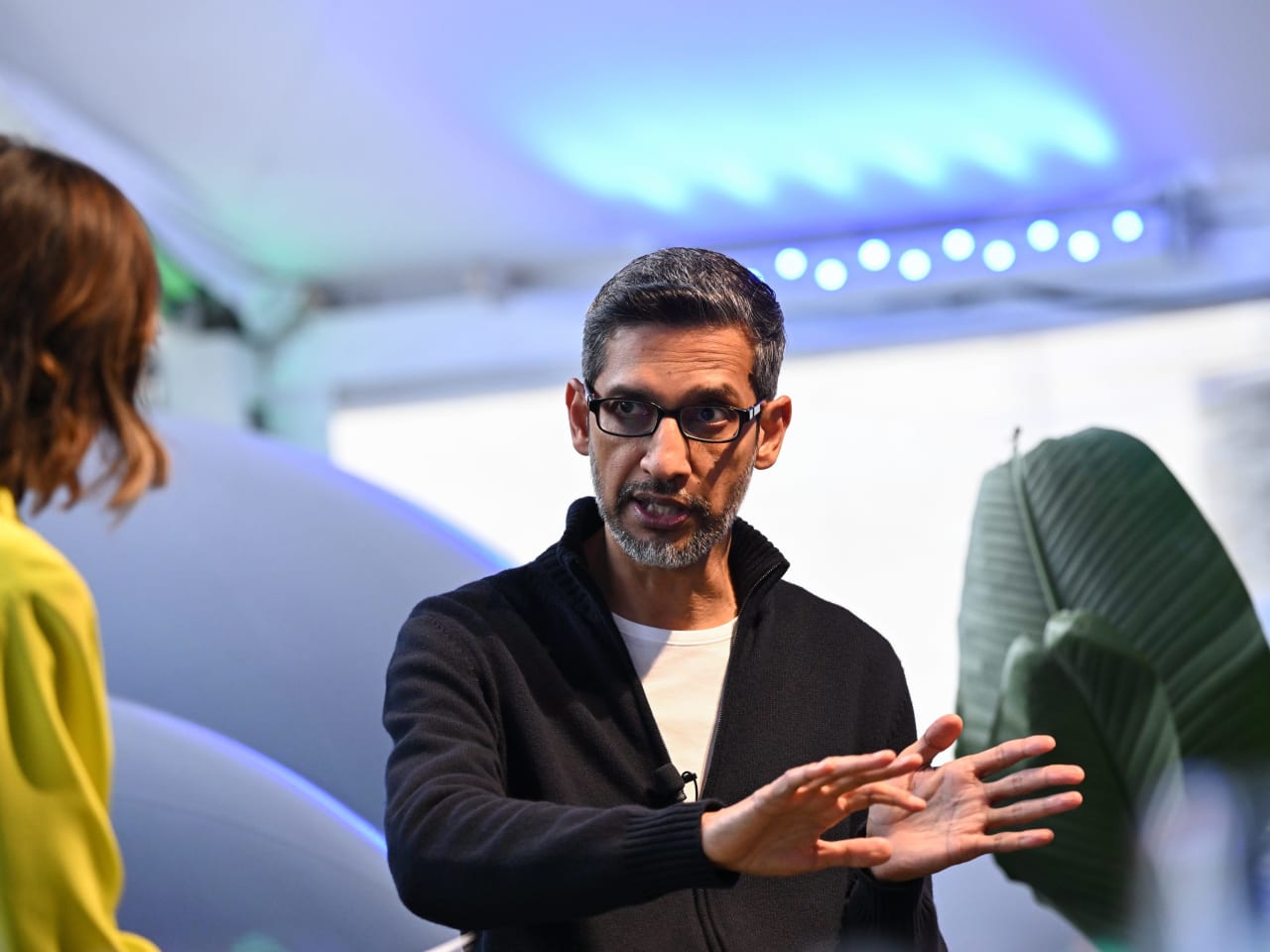
Sundar Pichai, chief executive of Alphabet Inc., during the Bloomberg Tech conference in San Francisco on June 4, 2025
David Paul Morris/Bloomberg via Getty Images
Google said its AI investments are leading to more searches than ever.
So why isn’t it making money at the same rate?
While Google gave some answers, they may not allay fears that AI is starting to cannibalize Search.
Is AI starting to hurt Google’s core search business? That’s the big lingering question following the company’s third-quarter earnings.
Google came out of the gates on Wednesday boasting that its year-over-year query growth rate was the highest in the last five years. It also saw a 12% increase in search revenue compared to this time last year.
Yet, Q3 search revenue missed the market estimates. Google’s share price was down around 10% after hours.
In short, Google’s AI investments have apparently led to more searches than ever, yet it’s not making money at the same rate.
That’s a big red flag for investors who have long been concerned, since the start of the AI boom, that the technology could directly threaten Google’s search business.
When asked about this gap on Wednesday’s earnings call, Google’s chief business officer Philipp Schindler blamed a variety of factors, including foreign-exchange headwinds, which the company expects to further impact the Search business next quarter. He also said the rising number of AI-related queries was out of step with how the company makes money from them.
“It’s worth noting that the strong growth in AI Mode queries had an impact because of the lower monetization we were seeing in AI Mode,” he said.
Schindler said that the company’s ad experiments had shown “promising results” and that it’s now scaling ads in AI Mode and Overviews to more queries .
A concerning gap for Google
From the moment ChatGPT took off in late 2022, Google investors have wondered whether the generative AI boom could pose an existential threat to Google’s business.
Not only has the rise of chatbots from OpenAI and other rivals offered users an alternative way to search, it has also forced Google to respond by disrupting its core Search advertising business.
Google CEO Sundar Pichai hinted on Wednesday’s earnings call that the dollars were lagging behind the changes it’s made to Search.
“Just like our shift to mobile over a decade ago, we are focused on building the best Search user experience, followed by monetization,” he said.
Veteran investor Gene Munster flagged Wednesday’s Search miss as a possible alarm bell for Google investors.
“Search had been beating estimates since March of 2025,” he wrote on X. “If this was a clean miss with no one-time factors, it will likely restart fears that generative AI and increasingly personalized bots will nibble away at growth.”
Investors will be holding out for Google to prove that its monetization efforts will pick up and that its Search cash cow can be as robust as ever in an AI era.
“Are more monetizable search queries being affected by AI surfaces and agents?” Mark Shmulik, a tech analyst at Bernstein Research, wrote in a note to investors.
Have something to share? Contact this reporter via email at hlangley@businessinsider.com or Signal at hughlangley.01. Use a personal email address and a non-work device; here’s our guide to sharing information securely .
Read the original article on Business Insider